Active Phase–Support Interaction in Phosphotungstic Acid-SiO2 Catalysts Enables Enhanced Olefin Oligomerization to Synthetic Fuel

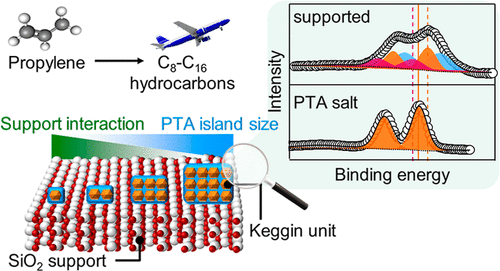
Transitioning the aviation sector to synthetic aviation fuels (SAF) requires innovative catalytic processes to overcome common limitations such as insufficient activity, selectivity, and catalyst deactivation. This study presents a detailed exploration of silica-supported phosphotungstic acid (PTA/SiO2) as a robust solid acid catalyst for propylene conversion into jet fuel-range hydrocarbons (C8 to C16) at mild reaction conditions (150 °C). The catalyst with optimized PTA loading (10 wt %) demonstrates significant oligomerization performance, achieving high selectivity to jet fuel-range hydrocarbons (>80%) and propylene conversion (>90%), alongside limited aromatic byproducts formation. Compared to conventional solid-acid catalysts such as a ZSM-5 zeolite, PTA/SiO2 exhibits significantly reduced catalyst deactivation and can be regenerated through mild thermal treatment (<400 °C). Detailed structural characterization revealed that PTA island size influences product selectivity. Increasing the PTA weight loading leads to larger active phase island sizes, with larger PTA islands preferentially producing longer-chain hydrocarbons (C15+). Raman spectroscopy confirms the preservation of the PTA Keggin structural integrity across all catalyst loadings, although perturbations in terminal W═O vibrations occur due to interactions with the SiO2 support. Crucially, insights obtained through combined XPS/HAXPES analyses reveal significant electronic interactions between PTA and SiO2, characterized by pronounced bending of the energy bands at the interface between semiconducting PTA and insulating SiO2. This effect generates interfacial tungsten states, which enhance localized electron mobility and facilitate proton transfer, significantly amplifying catalytic activity. Even catalysts with minimal Brønsted acidity (1 wt % PTA loading) exhibit notable turn over, emphasizing interfacial electronic modulation, rather than bulk acidity alone, as an important performance descriptor in olefin oligomerization.
January 2, 2026
Research paper Active Phase–Support Interaction in Phosphotungstic Acid-SiO2 Catalysts Enables Enhanced Olefin Oligomerization to Synthetic Fuel in ACS Catalysis

Read the full paper online:

Active Phase–Support Interaction in Phosphotungstic Acid-SiO2 Catalysts Enables Enhanced Olefin Oligomerization to Synthetic Fuel

Alessia Cesarini, Walid Dachraoui, Florent J. Dubray, Filippo Longo, Jonathan Muschietti, Daniel Rentsch, Rolf Erni, Ali J. Saadun, Jeroen A. van Bokhoven, Andreas Borgschulte


ACS Catalysis 2026, 16, 3, 2135–2148
DOI: 10.1021/acscatal.5c06512

Share this post
PUBLICATIONS

Latest findings from research

Research Paper Energy & Environmental Science
Papers

Haber–Bosch 2.0 for low-carbon ammonia production: a global techno-economic and environmental assessment

Decentralized ammonia production via electric Haber–Bosch (Haber–Bosch 2.0) could support shipping, chemical manufacturing, and local fertilizer supply chains. Unlike conventional Haber–Bosch systems, Haber–Bosch 2.0 technologies operate at lower pressures (∼30–60 bar) and temperatures (∼400 °C), enabling smaller, modular ammonia systems powered by low-carbon electricity. However, its economic viability and environmental performance under diverse conditions remain unclear. Here, we apply techno-economic and environmental life cycle assessment using a novel, open-source framework to optimally design ∼13 000 grid-connected, hybrid, and off-grid electric Haber–Bosch configurations worldwide. Our results demonstrate that decentralized ammonia production costs are between €740–4100 tNH3−1, which is substantially higher compared to centralized ammonia production (∼300 tNH3−1 historically with recent spikes up to ∼€800 tNH3−1). Hybrid configurations exhibit the lowest costs (€740–2090 tNH3−1), particularly in regions with low grid electricity prices, low capital costs, and/or abundant renewables. However, their GHG emissions vary widely depending on the GHG intensity of the local grid. Off-grid systems exhibit the lowest life cycle GHG emissions (on average 0.70 tCO2-eq. tNH3−1), but demonstrate high costs (more than €1100 tNH3−1), driven by oversized renewables and energy storage media to enable continuous Haber–Bosch operation. Cost parity may be achieved by 2050 through technology learning, especially for hybrid systems (€325 tNH3−1). To realize this potential and secure low-carbon fertilizer supply, policymakers should; (1) accelerate the decarbonization of national power grids, (2) provide early-stage deployment support for flexible, electric Haber–Bosch technologies, and (3) establish clear certification standards for low-carbon ammonia.
July 23, 2026
Research Paper Energy & Fuels
Papers

Prospective Life Cycle Assessment of Alternative Fuels and Carbon Capture in Swiss Gas-Fired Power Plants

Carbon-neutral energy systems will rely heavily on electrification and intermittent renewables, thereby increasing the need for flexible technologies such as gas turbines. Using alternative fuels in gas turbines could reduce greenhouse gas emissions and support net-zero goals, but their full life-cycle emissions impact has not been evaluated yet. This study presents a prospective life cycle assessment (LCA) of simple cycle gas turbines (SCGTs) in Switzerland, evaluating their performance with various alternative fuels and the potential integration of carbon capture technologies. The analysis considers domestically produced biomethane (from wood chips or biogas) and four e-fuels─e-hydrogen, e-methane, e-ammonia, and e-Fischer-Tropsch (e-FT) fuels─synthesized in regions with cost-effective renewable electricity in Spain, Iceland, and the Netherlands. Regarding carbon capture, we investigate both storage (CCS) and utilization (CCU), considering storage sites in Italy and Norway. The assessment covers multiple impact categories across 2035 and 2050. The results show that domestic biomethane provides a practical and climate-friendly option, reducing life-cycle climate impacts by nearly 80% in the near term and approaching 90% in the long term. In contrast, e-methane does not exceed an 80% reduction in the long term even under its most favorable production pathways. Both biomethane and e-methane can offer net-negative emissions if combined with CCS. Domestic CCU does not offer any environmental advantage if liquefying and transporting hydrogen (H2), instead of directly importing e-methane via pipeline. Multimodal transport increases environmental impacts compared to pipeline transport across several categories. Beyond climate impacts, alternative fuel production introduces trade-offs across most categories compared with natural gas. This study underscores that minimizing greenhouse gas emissions alone is insufficient and that system-level assessments are essential to minimize overall environmental impacts in future flexible power systems.
July 23, 2026