Haber–Bosch 2.0 for low-carbon ammonia production: a global techno-economic and environmental assessment
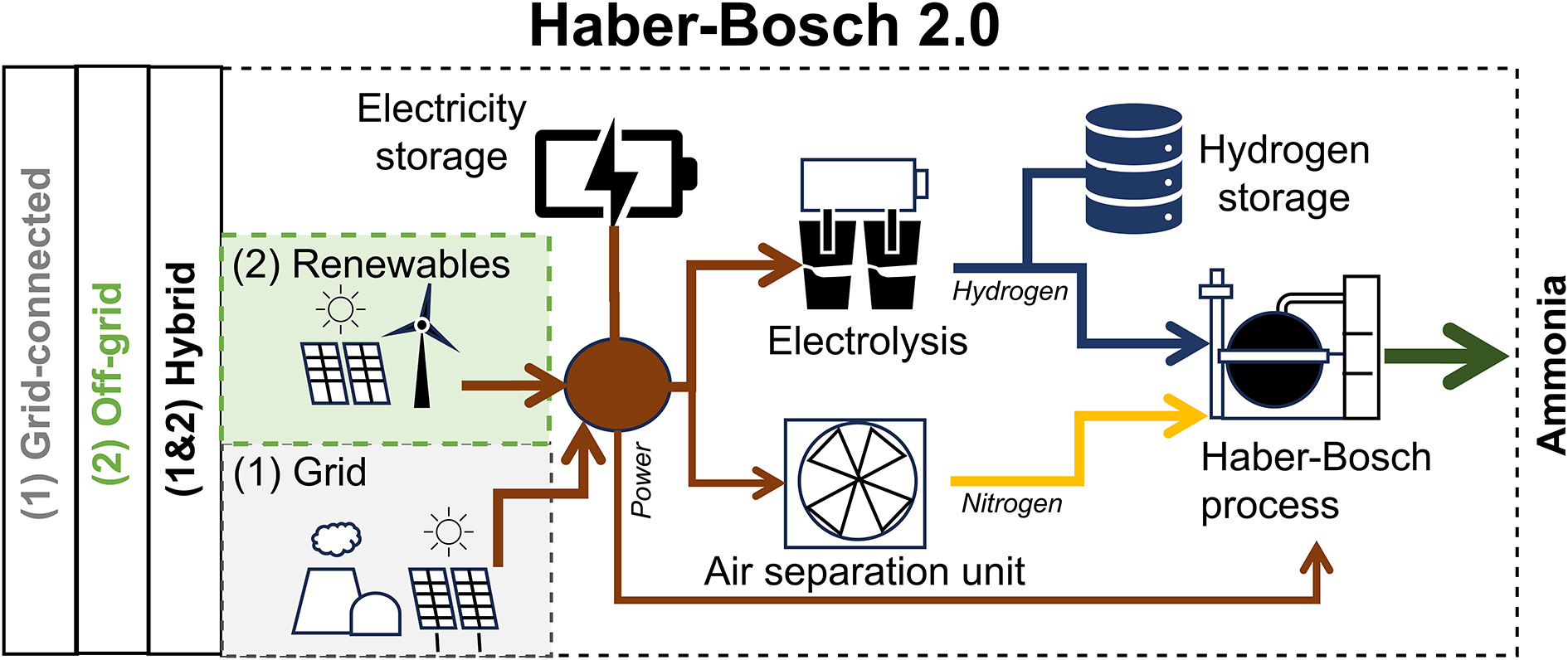
Decentralized ammonia production via electric Haber–Bosch (Haber–Bosch 2.0) could support shipping, chemical manufacturing, and local fertilizer supply chains. Unlike conventional Haber–Bosch systems, Haber–Bosch 2.0 technologies operate at lower pressures (∼30–60 bar) and temperatures (∼400 °C), enabling smaller, modular ammonia systems powered by low-carbon electricity. However, its economic viability and environmental performance under diverse conditions remain unclear. Here, we apply techno-economic and environmental life cycle assessment using a novel, open-source framework to optimally design ∼13 000 grid-connected, hybrid, and off-grid electric Haber–Bosch configurations worldwide. Our results demonstrate that decentralized ammonia production costs are between €740–4100 tNH3−1, which is substantially higher compared to centralized ammonia production (∼300 tNH3−1 historically with recent spikes up to ∼€800 tNH3−1). Hybrid configurations exhibit the lowest costs (€740–2090 tNH3−1), particularly in regions with low grid electricity prices, low capital costs, and/or abundant renewables. However, their GHG emissions vary widely depending on the GHG intensity of the local grid. Off-grid systems exhibit the lowest life cycle GHG emissions (on average 0.70 tCO2-eq. tNH3−1), but demonstrate high costs (more than €1100 tNH3−1), driven by oversized renewables and energy storage media to enable continuous Haber–Bosch operation. Cost parity may be achieved by 2050 through technology learning, especially for hybrid systems (€325 tNH3−1). To realize this potential and secure low-carbon fertilizer supply, policymakers should; (1) accelerate the decarbonization of national power grids, (2) provide early-stage deployment support for flexible, electric Haber–Bosch technologies, and (3) establish clear certification standards for low-carbon ammonia.
July 14, 2026
Research Paper Energy & Environmental Science
Read the full paper online:
Tom Terlouw, Christian Bauer, Peter Burgherr, Russell McKenna and Lorenzo Rosa
Energy & Environmental Science
2026
DOI: 10.1039/d6ee01125j
PUBLICATIONS