Active Phase–Support Interaction in Phosphotungstic Acid-SiO2 Catalysts Enables Enhanced Olefin Oligomerization to Synthetic Fuel

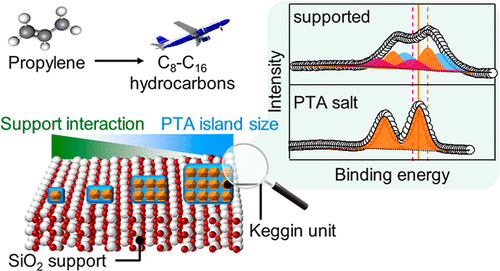
Transitioning the aviation sector to synthetic aviation fuels (SAF) requires innovative catalytic processes to overcome common limitations such as insufficient activity, selectivity, and catalyst deactivation. This study presents a detailed exploration of silica-supported phosphotungstic acid (PTA/SiO2) as a robust solid acid catalyst for propylene conversion into jet fuel-range hydrocarbons (C8 to C16) at mild reaction conditions (150 °C). The catalyst with optimized PTA loading (10 wt %) demonstrates significant oligomerization performance, achieving high selectivity to jet fuel-range hydrocarbons (>80%) and propylene conversion (>90%), alongside limited aromatic byproducts formation. Compared to conventional solid-acid catalysts such as a ZSM-5 zeolite, PTA/SiO2 exhibits significantly reduced catalyst deactivation and can be regenerated through mild thermal treatment (<400 °C). Detailed structural characterization revealed that PTA island size influences product selectivity. Increasing the PTA weight loading leads to larger active phase island sizes, with larger PTA islands preferentially producing longer-chain hydrocarbons (C15+). Raman spectroscopy confirms the preservation of the PTA Keggin structural integrity across all catalyst loadings, although perturbations in terminal W═O vibrations occur due to interactions with the SiO2 support. Crucially, insights obtained through combined XPS/HAXPES analyses reveal significant electronic interactions between PTA and SiO2, characterized by pronounced bending of the energy bands at the interface between semiconducting PTA and insulating SiO2. This effect generates interfacial tungsten states, which enhance localized electron mobility and facilitate proton transfer, significantly amplifying catalytic activity. Even catalysts with minimal Brønsted acidity (1 wt % PTA loading) exhibit notable turn over, emphasizing interfacial electronic modulation, rather than bulk acidity alone, as an important performance descriptor in olefin oligomerization.
January 2, 2026
Research paper Active Phase–Support Interaction in Phosphotungstic Acid-SiO2 Catalysts Enables Enhanced Olefin Oligomerization to Synthetic Fuel in ACS Catalysis

Read the full paper online:

Active Phase–Support Interaction in Phosphotungstic Acid-SiO2 Catalysts Enables Enhanced Olefin Oligomerization to Synthetic Fuel

Alessia Cesarini, Walid Dachraoui, Florent J. Dubray, Filippo Longo, Jonathan Muschietti, Daniel Rentsch, Rolf Erni, Ali J. Saadun, Jeroen A. van Bokhoven, Andreas Borgschulte


ACS Catalysis 2026, 16, 3, 2135–2148
‍DOI: 10.1021/acscatal.5c06512

‍

Share this post
PUBLICATIONS

Latest findings from research

Global economic and environmental trade-offs of power-to-liquid fuels
Documents

Global economic and environmental trade-offs of power-to-liquid fuels

Power-to-liquid (PtL) fuels are carbon-based liquid fuels made from hydrogen and carbon dioxide that can substitute fossil fuels in hard-to-electrify mobility sectors, particularly aviation and maritime transport, but their climate benefits depend strongly on how hydrogen, carbon dioxide, and electricity are supplied. Here, we assess global economic and environmental trade-offs for three PtL pathways: power-to-methanol, methanol-to-jet synthetic kerosene, and Fischer-Tropsch synthetic kerosene. We develop a high-resolution, spatially explicit framework that combines energy system optimization, techno-economic and prospective life cycle assessment. Low production costs and low greenhouse gas (GHG) emissions are often geographically misaligned today: renewable-rich regions such as North Africa, southern South America, and the Iberian Islands offer low-cost opportunities, whereas low-GHG grid-connected production is concentrated in regions with low-carbon power systems, such as Canada and northern Europe. Grid-connected production can be cost-effective but loses its climate advantage in carbon-intensive power systems, whereas off-grid renewable production delivers the lowest emissions at a cost premium. Configurations that combine grid electricity with dedicated renewables weaken this trade-off but remain sensitive to residual grid carbon intensity. For synthetic kerosene, Fischer-Tropsch routes are generally less GHG-intensive than methanol-to-jet routes under comparable electricity supply. Carbon pricing, sustainable aviation fuel (SAF) mandates, and fossil-fuel price volatility can narrow the cost gap, but mainly for configurations with low well-to-wake emissions. PtL deployment should therefore be guided by electricity supply, regional siting, and full life cycle impacts rather than fuel labels alone.
November 13, 2026
Balancing Selectivity Retention And Catalyst Restructuring In Pulsed CO2 Electroreduction On Silver
Documents

Balancing Selectivity Retention And Catalyst Restructuring In Pulsed CO2 Electroreduction On Silver

Pulsed electrochemical CO2 reduction has emerged as a strategy to extend electrolyzer lifetime by periodically interrupting reductive operation with short oxidative pulses. Here we investigate the effect of oxidative pulse potential, pulse frequency, and pulse duration on the selectivity and structural integrity of electrospun polymer-based silver gas diffusion electrodes over extended periods of operation. We show that the threshold potential for anodic dissolution of silver at 0.55 V vs. SHE defines an upper boundary for the pulse potential: pulses with a potential below this threshold enable periodic local acidification of the electrolyte in the vicinity of the catalyst promoting partial dissolution of (bi)carbonate precipitates, while pulses with a potential above the threshold drive a silver dissolution-redeposition cycle that restructures the catalyst into silver clusters promoting the hydrogen evolution reaction. Systematic exploration of the pulse parameter space identifies an optimal protocol consisting of 10-seconds-long oxidative pulses applied every 30 minutes, yielding a duty cycle exceeding 99%. Under these conditions, carbon product faradaic efficiency is maintained in the range of 70–80% over 100 hours of operation, representing a five-fold improvement in selectivity relative to continuous electrolysis. Our results demonstrate the potential of pulsed electrolysis to maintain high CO selectivity over long operational periods, thus representing an important step towards the industrialization of CO2 electrolysis.
November 13, 2026