2nd Annual Conference of the SWEET consortium refuel.ch
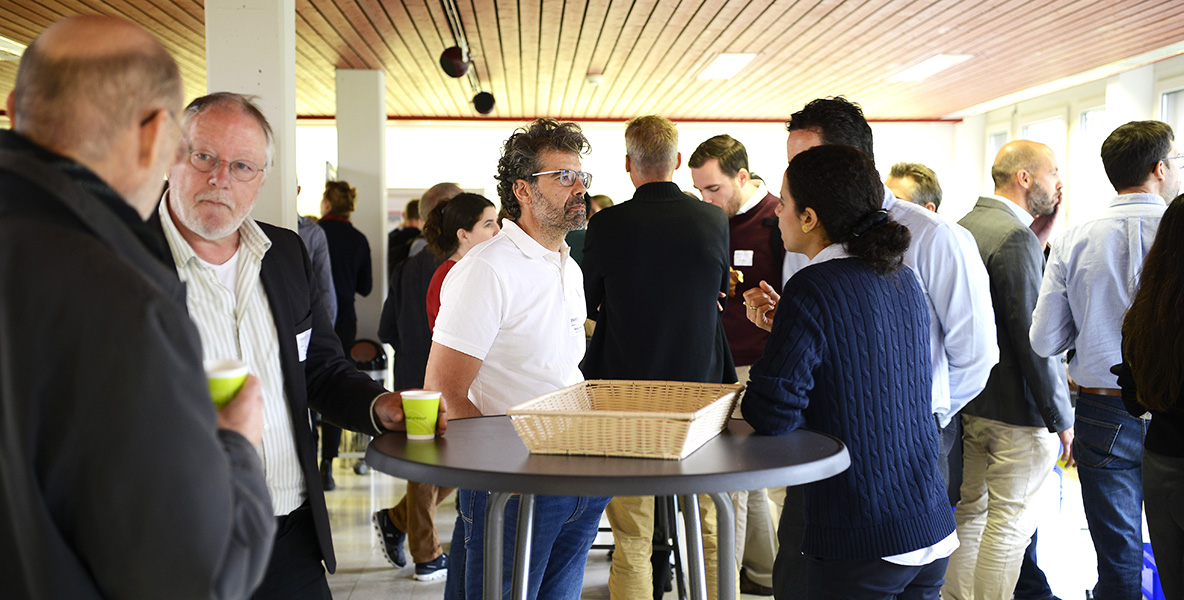
The second annual conference of the SWEET reFuel.ch consortium brought together nearly one hundred participants from national and international research, administration and industry at the Paul Scherrer Institute PSI in Villigen AG.
September 30, 2025
The coffee break offered the opportunity for further exchange and dialogue

The reFuel.ch community met for the sixth time to exchange knowledge and ideas following the kick-off in December 2023, the first annual conference at industry partner V-ZUG in 2024, and the round tables in 2024 and 2025. Each event has a different focus. At PSI, young and senior researchers presented the highlights from the ongoing work of the seven work packages.

The presentations included, for example, progress in identifying policy gaps and barriers related to the uptake of sustainable aviation fuels in Switzerland; first results of a survey on consumer preferences regarding the use of sustainable fuels in the industry, aviation or maritime sectors; and progress in modelling the implications of sustainable fuels production in exporting countries. They also highlighted progress in expanding a Swiss energy system model framework to incorporate the necessary components to determine robust pathways for sustainable fuel and platform chemicals production. The technical work packages presented new material developments for catalysts and membranes in the various technological paths investigated in reFuel.ch.

The two keynotes broadened the perspective and provided additional context: an important goal of the consortium is to place its results in the national and international political and social context, to compare Swiss industrial work with that of other countries, and to analyse the economic and the resource/procurement-dependent potential of sustainable fuels and platform chemicals.

Patricia Thornley, Director of the Energy and Bioproducts Research Institute and the Supergen Bioenergy Hub at Aston University in Birmingham, UK, presented the ‘Evaluation of the sustainability impacts of using biomass for energy and products’, how these are handled within the framework of the UK's policy sustainability targets, and how the global availability and environmental impact of biomass compares to that of other alternative fuels.
In the second keynote speech, Christian Moretti, reFuel.ch researcher at the Laboratory for Energy Systems Analysis at PSI, gave an overview on ‘E-fuels and chemicals: costs, efficiency and optimal use’.  During the two panel discussions with the presenters, the audience had the opportunity to ask their own questions, leading to lively discussions that continued during the breaks.

It was an all-round successful day, filled with the latest research findings and their economic and political implications. We are already looking forward to the next exchange at the online round table in November: information will follow soon on this page!

Share this post
PUBLICATIONS

Latest findings from research

Research Paper on global cost drivers for low-carbon fuels in Energy & Environmental Science
Papers

Global cost drivers and regional trade-offs for low-carbon fuels: a prospective techno-economic assessment

Low-carbon fuels (LCFs) such as green hydrogen, synthetic hydrocarbons, and biofuels are critical for decarbonizing sectors that are difficult to electrify. In this study, we present a globally harmonized techno-economic assessment of 21 LCF production pathways, including power-to-X, biomass- and sun-to-liquids, and multiple hydrogen routes, evaluated across all countries under three future scenarios for 2024, 2030, and 2050. The model integrates spatially explicit resource data, learning-driven capital cost trajectories, and dynamic, country- and technology-specific costs of capital, supported by robust scenarios and uncertainty analysis. By 2050, median levelized costs are projected to range from 0.07 to 0.10 EUR2024 per kWh for green hydrogen, 0.15 to 0.18 EUR2024 per kWh for power-to-liquid kerosene, and 0.14 to 0.20 EUR2024 per kWh for most bio-based aviation fuels, reflecting both substantial progress and persistent regional disparities. Our results show that while innovation, technology learning, and deep power sector decarbonization can unlock cost-competitive electrofuels in countries with abundant renewables, bio-based routes are frequently cost competitive for sustainable aviation fuel (SAF) production in near-term scenarios, and solar-to-liquid fuels remain constrained by feedstock availability and capital barriers. Nuclear- and methane-based hydrogen emerge as primary options in many regions, as well as the dominance of turquoise hydrogen in Russia, the Middle East, and Central Asia where carbon management is viable, which highlights the context-specific nature of future LCF systems. We also found that the least-cost logistics for global hydrogen trade will shift from ammonia shipping to pipeline transport and methanol delivery, with North Africa and Iberia emerging as leading suppliers to Europe. These findings underscore the need for integrated innovation, policy coordination, and investment strategies that address both resource and financial barriers, in order to achieve scalable, resilient, and cost-effective LCF supply chains worldwide.
March 17, 2026
Research paper Active Phase–Support Interaction in Phosphotungstic Acid-SiO2 Catalysts Enables Enhanced Olefin Oligomerization to Synthetic Fuel in ACS Catalysis
Papers

Active Phase–Support Interaction in Phosphotungstic Acid-SiO2 Catalysts Enables Enhanced Olefin Oligomerization to Synthetic Fuel

Transitioning the aviation sector to synthetic aviation fuels (SAF) requires innovative catalytic processes to overcome common limitations such as insufficient activity, selectivity, and catalyst deactivation. This study presents a detailed exploration of silica-supported phosphotungstic acid (PTA/SiO2) as a robust solid acid catalyst for propylene conversion into jet fuel-range hydrocarbons (C8 to C16) at mild reaction conditions (150 °C). The catalyst with optimized PTA loading (10 wt %) demonstrates significant oligomerization performance, achieving high selectivity to jet fuel-range hydrocarbons (>80%) and propylene conversion (>90%), alongside limited aromatic byproducts formation. Compared to conventional solid-acid catalysts such as a ZSM-5 zeolite, PTA/SiO2 exhibits significantly reduced catalyst deactivation and can be regenerated through mild thermal treatment (<400 °C). Detailed structural characterization revealed that PTA island size influences product selectivity. Increasing the PTA weight loading leads to larger active phase island sizes, with larger PTA islands preferentially producing longer-chain hydrocarbons (C15+). Raman spectroscopy confirms the preservation of the PTA Keggin structural integrity across all catalyst loadings, although perturbations in terminal W═O vibrations occur due to interactions with the SiO2 support. Crucially, insights obtained through combined XPS/HAXPES analyses reveal significant electronic interactions between PTA and SiO2, characterized by pronounced bending of the energy bands at the interface between semiconducting PTA and insulating SiO2. This effect generates interfacial tungsten states, which enhance localized electron mobility and facilitate proton transfer, significantly amplifying catalytic activity. Even catalysts with minimal Brønsted acidity (1 wt % PTA loading) exhibit notable turn over, emphasizing interfacial electronic modulation, rather than bulk acidity alone, as an important performance descriptor in olefin oligomerization.
March 17, 2026