Global cost drivers and regional trade-offs for low-carbon fuels: a prospective techno-economic assessment

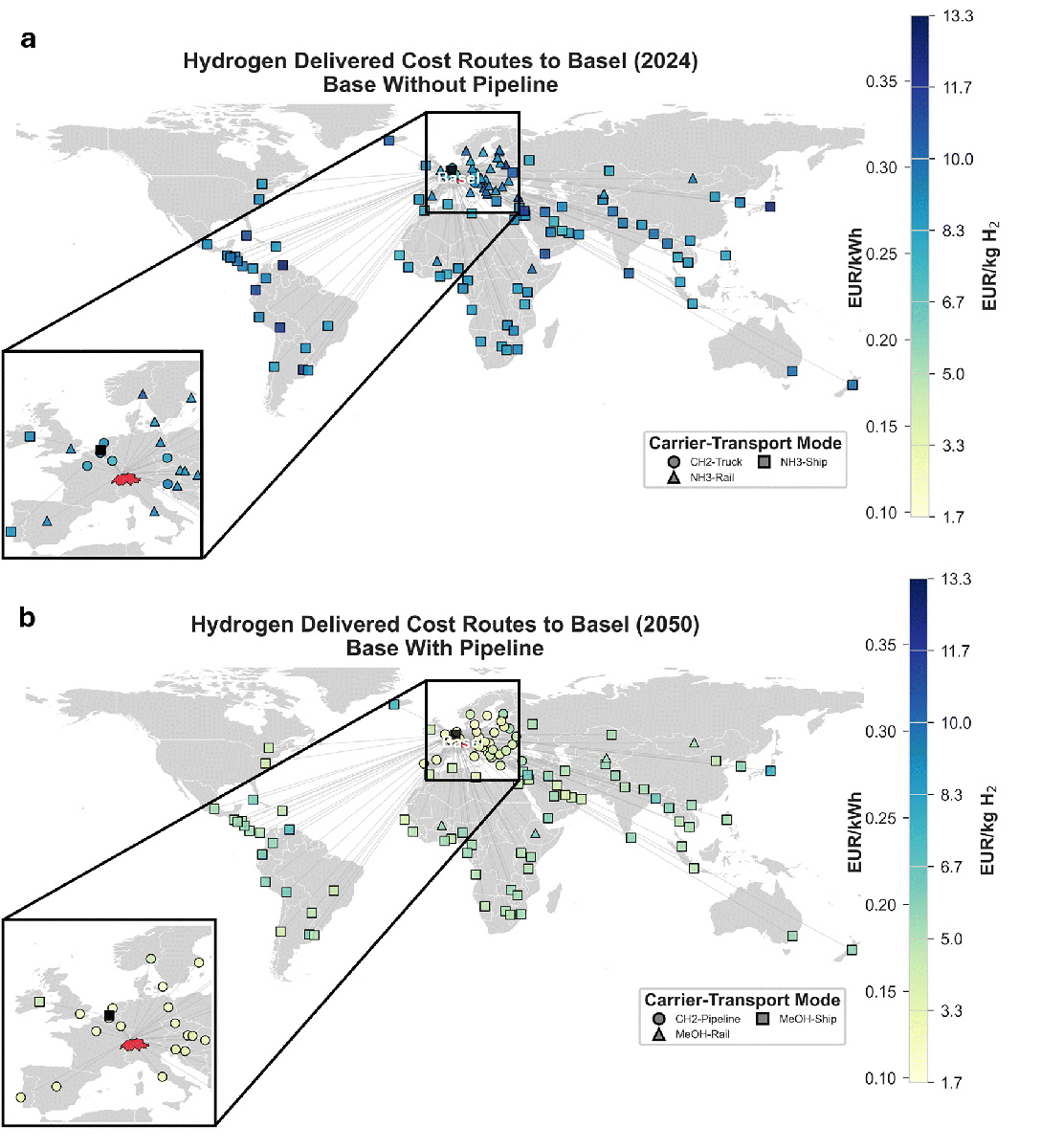
Low-carbon fuels (LCFs) such as green hydrogen, synthetic hydrocarbons, and biofuels are critical for decarbonizing sectors that are difficult to electrify. In this study, we present a globally harmonized techno-economic assessment of 21 LCF production pathways, including power-to-X, biomass- and sun-to-liquids, and multiple hydrogen routes, evaluated across all countries under three future scenarios for 2024, 2030, and 2050. The model integrates spatially explicit resource data, learning-driven capital cost trajectories, and dynamic, country- and technology-specific costs of capital, supported by robust scenarios and uncertainty analysis. By 2050, median levelized costs are projected to range from 0.07 to 0.10 EUR2024 per kWh for green hydrogen, 0.15 to 0.18 EUR2024 per kWh for power-to-liquid kerosene, and 0.14 to 0.20 EUR2024 per kWh for most bio-based aviation fuels, reflecting both substantial progress and persistent regional disparities. Our results show that while innovation, technology learning, and deep power sector decarbonization can unlock cost-competitive electrofuels in countries with abundant renewables, bio-based routes are frequently cost competitive for sustainable aviation fuel (SAF) production in near-term scenarios, and solar-to-liquid fuels remain constrained by feedstock availability and capital barriers. Nuclear- and methane-based hydrogen emerge as primary options in many regions, as well as the dominance of turquoise hydrogen in Russia, the Middle East, and Central Asia where carbon management is viable, which highlights the context-specific nature of future LCF systems. We also found that the least-cost logistics for global hydrogen trade will shift from ammonia shipping to pipeline transport and methanol delivery, with North Africa and Iberia emerging as leading suppliers to Europe. These findings underscore the need for integrated innovation, policy coordination, and investment strategies that address both resource and financial barriers, in order to achieve scalable, resilient, and cost-effective LCF supply chains worldwide.
February 20, 2026

Research Paper on global cost drivers for low-carbon fuels in Energy & Environmental Science

Read the full paper online:

Global cost drivers and regional trade-offs for low-carbon fuels: a prospective techno-economic assessment

Zipeng Liu, Tom Terlouw, Patrick Frey, Christian Bauer, Russell McKenna


Energy & Environmental Science
2026, Advance Article
DOI: 10.1039/d5ee05591a

Share this post
PUBLICATIONS

Latest findings from research

Research Paper Energy & Environmental Science
Papers

Haber–Bosch 2.0 for low-carbon ammonia production: a global techno-economic and environmental assessment

Decentralized ammonia production via electric Haber–Bosch (Haber–Bosch 2.0) could support shipping, chemical manufacturing, and local fertilizer supply chains. Unlike conventional Haber–Bosch systems, Haber–Bosch 2.0 technologies operate at lower pressures (∼30–60 bar) and temperatures (∼400 °C), enabling smaller, modular ammonia systems powered by low-carbon electricity. However, its economic viability and environmental performance under diverse conditions remain unclear. Here, we apply techno-economic and environmental life cycle assessment using a novel, open-source framework to optimally design ∼13 000 grid-connected, hybrid, and off-grid electric Haber–Bosch configurations worldwide. Our results demonstrate that decentralized ammonia production costs are between €740–4100 tNH3−1, which is substantially higher compared to centralized ammonia production (∼300 tNH3−1 historically with recent spikes up to ∼€800 tNH3−1). Hybrid configurations exhibit the lowest costs (€740–2090 tNH3−1), particularly in regions with low grid electricity prices, low capital costs, and/or abundant renewables. However, their GHG emissions vary widely depending on the GHG intensity of the local grid. Off-grid systems exhibit the lowest life cycle GHG emissions (on average 0.70 tCO2-eq. tNH3−1), but demonstrate high costs (more than €1100 tNH3−1), driven by oversized renewables and energy storage media to enable continuous Haber–Bosch operation. Cost parity may be achieved by 2050 through technology learning, especially for hybrid systems (€325 tNH3−1). To realize this potential and secure low-carbon fertilizer supply, policymakers should; (1) accelerate the decarbonization of national power grids, (2) provide early-stage deployment support for flexible, electric Haber–Bosch technologies, and (3) establish clear certification standards for low-carbon ammonia.
July 23, 2026
Research Paper Energy & Fuels
Papers

Prospective Life Cycle Assessment of Alternative Fuels and Carbon Capture in Swiss Gas-Fired Power Plants

Carbon-neutral energy systems will rely heavily on electrification and intermittent renewables, thereby increasing the need for flexible technologies such as gas turbines. Using alternative fuels in gas turbines could reduce greenhouse gas emissions and support net-zero goals, but their full life-cycle emissions impact has not been evaluated yet. This study presents a prospective life cycle assessment (LCA) of simple cycle gas turbines (SCGTs) in Switzerland, evaluating their performance with various alternative fuels and the potential integration of carbon capture technologies. The analysis considers domestically produced biomethane (from wood chips or biogas) and four e-fuels─e-hydrogen, e-methane, e-ammonia, and e-Fischer-Tropsch (e-FT) fuels─synthesized in regions with cost-effective renewable electricity in Spain, Iceland, and the Netherlands. Regarding carbon capture, we investigate both storage (CCS) and utilization (CCU), considering storage sites in Italy and Norway. The assessment covers multiple impact categories across 2035 and 2050. The results show that domestic biomethane provides a practical and climate-friendly option, reducing life-cycle climate impacts by nearly 80% in the near term and approaching 90% in the long term. In contrast, e-methane does not exceed an 80% reduction in the long term even under its most favorable production pathways. Both biomethane and e-methane can offer net-negative emissions if combined with CCS. Domestic CCU does not offer any environmental advantage if liquefying and transporting hydrogen (H2), instead of directly importing e-methane via pipeline. Multimodal transport increases environmental impacts compared to pipeline transport across several categories. Beyond climate impacts, alternative fuel production introduces trade-offs across most categories compared with natural gas. This study underscores that minimizing greenhouse gas emissions alone is insufficient and that system-level assessments are essential to minimize overall environmental impacts in future flexible power systems.
July 23, 2026