Global greenhouse gas emissions mitigation potential of existing and planned hydrogen projects
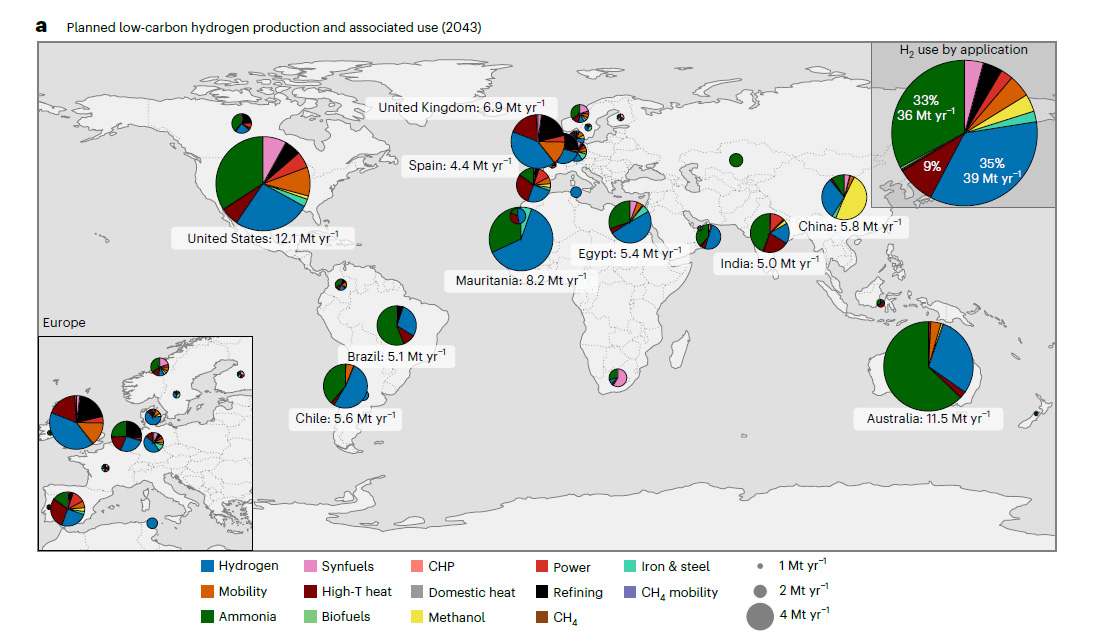
Hydrogen will play a critical role in decarbonizing diverse economic sectors. However, given limited sustainable resources and the energy-intensive nature of its production, prioritizing its applications will be essential. Here, we analyse approximately 2,000 (low-carbon) hydrogen projects worldwide, encompassing operational and planned initiatives until 2043, quantifying their greenhouse gas (GHG) emissions and mitigation potential from a life cycle perspective. Our results demonstrate the variability in GHG emissions of hydrogen applications, depending on the geographical location and hydrogen source used. The most climate-effective hydrogen applications include steel-making, biofuels and ammonia, while hydrogen use for road transport, power generation and domestic heating should be discouraged as more favourable alternatives exist. Planned low-carbon hydrogen projects could generate 110 MtH2 yr−1, emit approximately 0.4 GtCO2e yr−1, and potentially reduce net life cycle GHG emissions by 0.2–1.1 GtCO2e yr−1 by 2043, depending on the substituted product or service. Addressing the current hydrogen implementation gap and prioritizing climate-effective applications are crucial for meeting decarbonization goals.
November 6, 2025

Research Paper nature energy
Read the full paper online:
Global greenhouse gas emissions mitigation potential of existing and planned hydrogen projects
Tom Terlouw, Christian Moretti, Carina Harpprecht, et al.
Nature Energy
2025 10, pp. 1503-1515
DOI: 10.1038/s41560-025-01892-9
PUBLICATIONS