reFuel.ch 4th Round Table Highlights Regulatory and Production Challenges for Sustainable Fuels
The fourth virtual Round Table of the SWEET Consortium reFuel.ch, held on November 19, brought together 76 participants from industry, public administration, and academia. Taking place twice a year, the event fosters knowledge exchange on technology and policy readiness and tracks developments in the emerging market for renewable and low-carbon fuels.
November 19, 2025
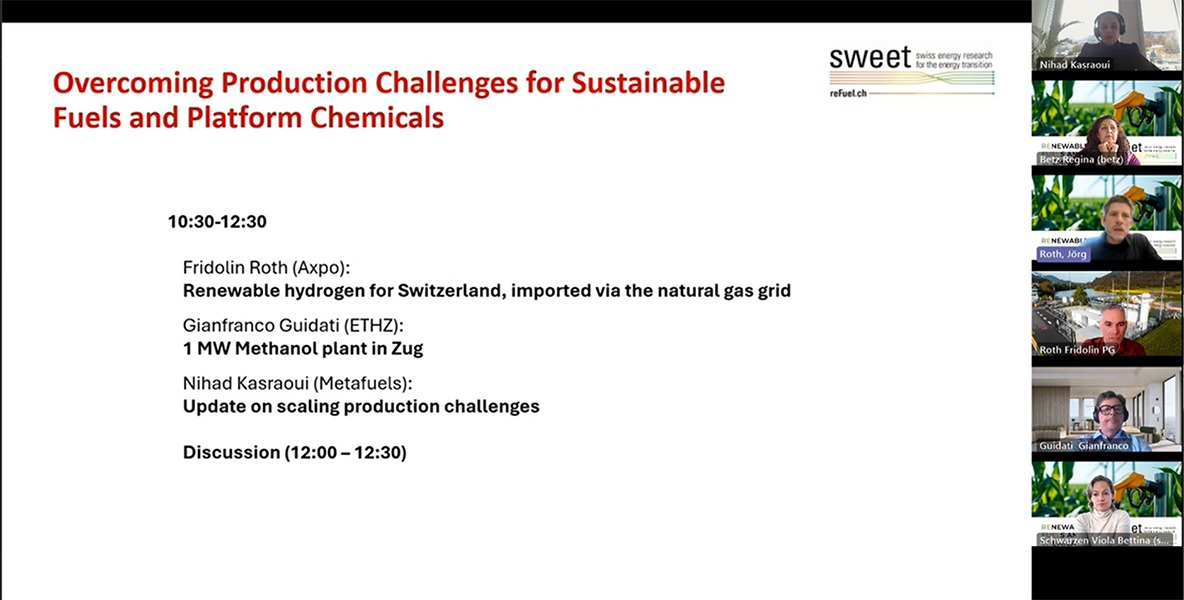
Speakers and organizers of the fourth virtual reFuel.ch Round Table exchanging insights on production pathways for sustainable fuels, 19 November 2025

Regulatory Frameworks Under Scrutiny

The first session, moderated by consortium co-lead Regina Betz (ZHAW), focused on regulatory implementation. Frank Hayer from the Federal Office of the Environment (FOEN) outlined Switzerland's approach, while refuel.ch WP1 lead Ilaria Espa (USI) presented the European Union's framework. Consortium co-lead Christian Bach (Empa) discussed practical aspects of certifying sustainable fuels and transporting them to Switzerland drawing from the new Swiss Guarantee of Origin regulation.        

The discussion highlighted key regulatory differences between Switzerland and the EU. While Switzerland allows also Life Cycle Analysis (stemming from earlier mineral oil tax rules), the EU requires RED-III certification. These diverging approaches sparked questions about the new Swiss Guarantee of Origin system at Pronovo and its interaction with EU RED-III regulation for transporting and declaration requirements for blended imported fuels. Participants also raised important integrity concerns — such as the risk of misclassifying virgin palm oil as wastecooking oil.


Overcoming Production Challenges for Sustainable Fuels and Platform Chemicals

The second session addressed challenges in production and scale-up. Jörg Roth (PSI) welcomed Fridolin Roth (Axpo), who presented on Renewable Hydrogen for Switzerland imported via the natural gas grid. Gianfranco Guidati (ETHZ) shared insights from the 1 MW Methanol plant in Zug, and Nihad Kasraoui (Metafuels) provided an update on scaling production.

The main takeaways were that in the current environment, offtake agreements are key to move renewable fuel projects forward and for successful scale up. Even commercially modest projects — such as hydrogen blended into natural gas — were highlighted as important steps in building market confidence. All speakers agree that Methanol is an important intermediate and enabler for climate neutral fuels and chemicals to power applications that can’t be electrified in the mid-term.

Share this post
PUBLICATIONS

Latest findings from research

Global economic and environmental trade-offs of power-to-liquid fuels
Documents

Global economic and environmental trade-offs of power-to-liquid fuels

Power-to-liquid (PtL) fuels are carbon-based liquid fuels made from hydrogen and carbon dioxide that can substitute fossil fuels in hard-to-electrify mobility sectors, particularly aviation and maritime transport, but their climate benefits depend strongly on how hydrogen, carbon dioxide, and electricity are supplied. Here, we assess global economic and environmental trade-offs for three PtL pathways: power-to-methanol, methanol-to-jet synthetic kerosene, and Fischer-Tropsch synthetic kerosene. We develop a high-resolution, spatially explicit framework that combines energy system optimization, techno-economic and prospective life cycle assessment. Low production costs and low greenhouse gas (GHG) emissions are often geographically misaligned today: renewable-rich regions such as North Africa, southern South America, and the Iberian Islands offer low-cost opportunities, whereas low-GHG grid-connected production is concentrated in regions with low-carbon power systems, such as Canada and northern Europe. Grid-connected production can be cost-effective but loses its climate advantage in carbon-intensive power systems, whereas off-grid renewable production delivers the lowest emissions at a cost premium. Configurations that combine grid electricity with dedicated renewables weaken this trade-off but remain sensitive to residual grid carbon intensity. For synthetic kerosene, Fischer-Tropsch routes are generally less GHG-intensive than methanol-to-jet routes under comparable electricity supply. Carbon pricing, sustainable aviation fuel (SAF) mandates, and fossil-fuel price volatility can narrow the cost gap, but mainly for configurations with low well-to-wake emissions. PtL deployment should therefore be guided by electricity supply, regional siting, and full life cycle impacts rather than fuel labels alone.
November 13, 2026
Balancing Selectivity Retention And Catalyst Restructuring In Pulsed CO2 Electroreduction On Silver
Documents

Balancing Selectivity Retention And Catalyst Restructuring In Pulsed CO2 Electroreduction On Silver

Pulsed electrochemical CO2 reduction has emerged as a strategy to extend electrolyzer lifetime by periodically interrupting reductive operation with short oxidative pulses. Here we investigate the effect of oxidative pulse potential, pulse frequency, and pulse duration on the selectivity and structural integrity of electrospun polymer-based silver gas diffusion electrodes over extended periods of operation. We show that the threshold potential for anodic dissolution of silver at 0.55 V vs. SHE defines an upper boundary for the pulse potential: pulses with a potential below this threshold enable periodic local acidification of the electrolyte in the vicinity of the catalyst promoting partial dissolution of (bi)carbonate precipitates, while pulses with a potential above the threshold drive a silver dissolution-redeposition cycle that restructures the catalyst into silver clusters promoting the hydrogen evolution reaction. Systematic exploration of the pulse parameter space identifies an optimal protocol consisting of 10-seconds-long oxidative pulses applied every 30 minutes, yielding a duty cycle exceeding 99%. Under these conditions, carbon product faradaic efficiency is maintained in the range of 70–80% over 100 hours of operation, representing a five-fold improvement in selectivity relative to continuous electrolysis. Our results demonstrate the potential of pulsed electrolysis to maintain high CO selectivity over long operational periods, thus representing an important step towards the industrialization of CO2 electrolysis.
November 13, 2026