Global greenhouse gas emissions mitigation potential of existing and planned hydrogen projects

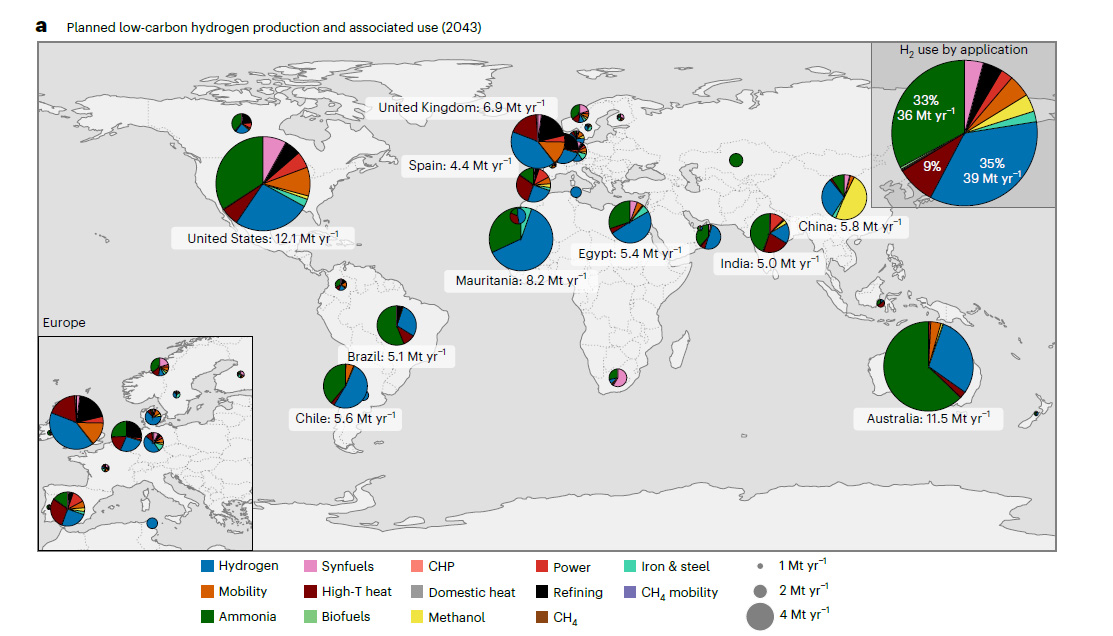
Hydrogen will play a critical role in decarbonizing diverse economic sectors. However, given limited sustainable resources and the energy-intensive nature of its production, prioritizing its applications will be essential. Here, we analyse approximately 2,000 (low-carbon) hydrogen projects worldwide, encompassing operational and planned initiatives until 2043, quantifying their greenhouse gas (GHG) emissions and mitigation potential from a life cycle perspective. Our results demonstrate the variability in GHG emissions of hydrogen applications, depending on the geographical location and hydrogen source used. The most climate-effective hydrogen applications include steel-making, biofuels and ammonia, while hydrogen use for road transport, power generation and domestic heating should be discouraged as more favourable alternatives exist. Planned low-carbon hydrogen projects could generate 110 MtH2 yr−1, emit approximately 0.4 GtCO2e yr−1, and potentially reduce net life cycle GHG emissions by 0.2–1.1 GtCO2e yr−1 by 2043, depending on the substituted product or service. Addressing the current hydrogen implementation gap and prioritizing climate-effective applications are crucial for meeting decarbonization goals.
November 6, 2025
Research Paper nature energy

Read the full paper online:

Global greenhouse gas emissions mitigation potential of existing and planned hydrogen projects

Tom Terlouw, Christian Moretti, Carina Harpprecht, et al.


Nature Energy
2025 10, pp. 1503-1515
‍DOI: 10.1038/s41560-025-01892-9

‍

‍

Share this post
PUBLICATIONS

Latest findings from research

Research Paper Energy & Environmental Science
Publikationen

Haber–Bosch 2.0 for low-carbon ammonia production: a global techno-economic and environmental assessment

Decentralized ammonia production via electric Haber–Bosch (Haber–Bosch 2.0) could support shipping, chemical manufacturing, and local fertilizer supply chains. Unlike conventional Haber–Bosch systems, Haber–Bosch 2.0 technologies operate at lower pressures (∼30–60 bar) and temperatures (∼400 °C), enabling smaller, modular ammonia systems powered by low-carbon electricity. However, its economic viability and environmental performance under diverse conditions remain unclear. Here, we apply techno-economic and environmental life cycle assessment using a novel, open-source framework to optimally design ∼13 000 grid-connected, hybrid, and off-grid electric Haber–Bosch configurations worldwide. Our results demonstrate that decentralized ammonia production costs are between €740–4100 tNH3−1, which is substantially higher compared to centralized ammonia production (∼300 tNH3−1 historically with recent spikes up to ∼€800 tNH3−1). Hybrid configurations exhibit the lowest costs (€740–2090 tNH3−1), particularly in regions with low grid electricity prices, low capital costs, and/or abundant renewables. However, their GHG emissions vary widely depending on the GHG intensity of the local grid. Off-grid systems exhibit the lowest life cycle GHG emissions (on average 0.70 tCO2-eq. tNH3−1), but demonstrate high costs (more than €1100 tNH3−1), driven by oversized renewables and energy storage media to enable continuous Haber–Bosch operation. Cost parity may be achieved by 2050 through technology learning, especially for hybrid systems (€325 tNH3−1). To realize this potential and secure low-carbon fertilizer supply, policymakers should; (1) accelerate the decarbonization of national power grids, (2) provide early-stage deployment support for flexible, electric Haber–Bosch technologies, and (3) establish clear certification standards for low-carbon ammonia.
October 9, 2026