Balancing Selectivity Retention And Catalyst Restructuring In Pulsed CO2 Electroreduction On Silver

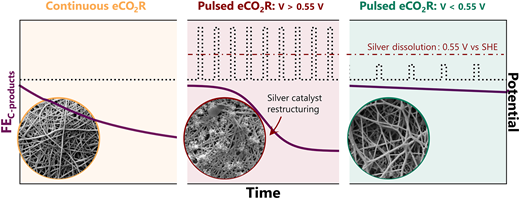
Pulsed electrochemical CO2 reduction has emerged as a strategy to extend electrolyzer lifetime by periodically interrupting reductive operation with short oxidative pulses. Here we investigate the effect of oxidative pulse potential, pulse frequency, and pulse duration on the selectivity and structural integrity of electrospun polymer-based silver gas diffusion electrodes over extended periods of operation. We show that the threshold potential for anodic dissolution of silver at 0.55 V vs. SHE defines an upper boundary for the pulse potential: pulses with a potential below this threshold enable periodic local acidification of the electrolyte in the vicinity of the catalyst promoting partial dissolution of (bi)carbonate precipitates, while pulses with a potential above the threshold drive a silver dissolution-redeposition cycle that restructures the catalyst into silver clusters promoting the hydrogen evolution reaction. Systematic exploration of the pulse parameter space identifies an optimal protocol consisting of 10-seconds-long oxidative pulses applied every 30 minutes, yielding a duty cycle exceeding 99%. Under these conditions, carbon product faradaic efficiency is maintained in the range of 70–80% over 100 hours of operation, representing a five-fold improvement in selectivity relative to continuous electrolysis. Our results demonstrate the potential of pulsed electrolysis to maintain high CO selectivity over long operational periods, thus representing an important step towards the industrialization of CO2 electrolysis.
November 1, 2026
Balancing Selectivity Retention And Catalyst Restructuring In Pulsed CO2 Electroreduction On Silver

‍

Read the full paper online:

Balancing selectivity retention and catalyst restructuring in pulsed CO2 electroreduction on silver

C. Bissattini Alessi, R. Rajadhyax, A. Senocrate, C. Battaglia

EEC Catalysis
2026

‍DOI: https://doi.org/10.1039/d6ey00140h

‍

Share this post
PUBLICATIONS

Latest findings from research

Global economic and environmental trade-offs of power-to-liquid fuels
Publikationen

Global economic and environmental trade-offs of power-to-liquid fuels

Power-to-liquid (PtL) fuels are carbon-based liquid fuels made from hydrogen and carbon dioxide that can substitute fossil fuels in hard-to-electrify mobility sectors, particularly aviation and maritime transport, but their climate benefits depend strongly on how hydrogen, carbon dioxide, and electricity are supplied. Here, we assess global economic and environmental trade-offs for three PtL pathways: power-to-methanol, methanol-to-jet synthetic kerosene, and Fischer-Tropsch synthetic kerosene. We develop a high-resolution, spatially explicit framework that combines energy system optimization, techno-economic and prospective life cycle assessment. Low production costs and low greenhouse gas (GHG) emissions are often geographically misaligned today: renewable-rich regions such as North Africa, southern South America, and the Iberian Islands offer low-cost opportunities, whereas low-GHG grid-connected production is concentrated in regions with low-carbon power systems, such as Canada and northern Europe. Grid-connected production can be cost-effective but loses its climate advantage in carbon-intensive power systems, whereas off-grid renewable production delivers the lowest emissions at a cost premium. Configurations that combine grid electricity with dedicated renewables weaken this trade-off but remain sensitive to residual grid carbon intensity. For synthetic kerosene, Fischer-Tropsch routes are generally less GHG-intensive than methanol-to-jet routes under comparable electricity supply. Carbon pricing, sustainable aviation fuel (SAF) mandates, and fossil-fuel price volatility can narrow the cost gap, but mainly for configurations with low well-to-wake emissions. PtL deployment should therefore be guided by electricity supply, regional siting, and full life cycle impacts rather than fuel labels alone.
November 13, 2026
Research Paper Energy & Environmental Science
Publikationen

Haber–Bosch 2.0 for low-carbon ammonia production: a global techno-economic and environmental assessment

Decentralized ammonia production via electric Haber–Bosch (Haber–Bosch 2.0) could support shipping, chemical manufacturing, and local fertilizer supply chains. Unlike conventional Haber–Bosch systems, Haber–Bosch 2.0 technologies operate at lower pressures (∼30–60 bar) and temperatures (∼400 °C), enabling smaller, modular ammonia systems powered by low-carbon electricity. However, its economic viability and environmental performance under diverse conditions remain unclear. Here, we apply techno-economic and environmental life cycle assessment using a novel, open-source framework to optimally design ∼13 000 grid-connected, hybrid, and off-grid electric Haber–Bosch configurations worldwide. Our results demonstrate that decentralized ammonia production costs are between €740–4100 tNH3−1, which is substantially higher compared to centralized ammonia production (∼300 tNH3−1 historically with recent spikes up to ∼€800 tNH3−1). Hybrid configurations exhibit the lowest costs (€740–2090 tNH3−1), particularly in regions with low grid electricity prices, low capital costs, and/or abundant renewables. However, their GHG emissions vary widely depending on the GHG intensity of the local grid. Off-grid systems exhibit the lowest life cycle GHG emissions (on average 0.70 tCO2-eq. tNH3−1), but demonstrate high costs (more than €1100 tNH3−1), driven by oversized renewables and energy storage media to enable continuous Haber–Bosch operation. Cost parity may be achieved by 2050 through technology learning, especially for hybrid systems (€325 tNH3−1). To realize this potential and secure low-carbon fertilizer supply, policymakers should; (1) accelerate the decarbonization of national power grids, (2) provide early-stage deployment support for flexible, electric Haber–Bosch technologies, and (3) establish clear certification standards for low-carbon ammonia.
October 9, 2026