1. Annual Conference of the SWEET consortium reFuel.ch

Experts from research and industry discussed the technical and regulatory challenges of implementing sustainable fuels and platform chemicals at the first annual conference of the SWEET Consortium reFuel.ch.
September 23, 2024
“Project portfolio and degree of implementation make the fulfillment of the EU SAF quota likely, the PtL quota unlikely.” stated Bernhard Dietrich, at the 1. Annual Conference of the SWEET consortium reFuel.ch

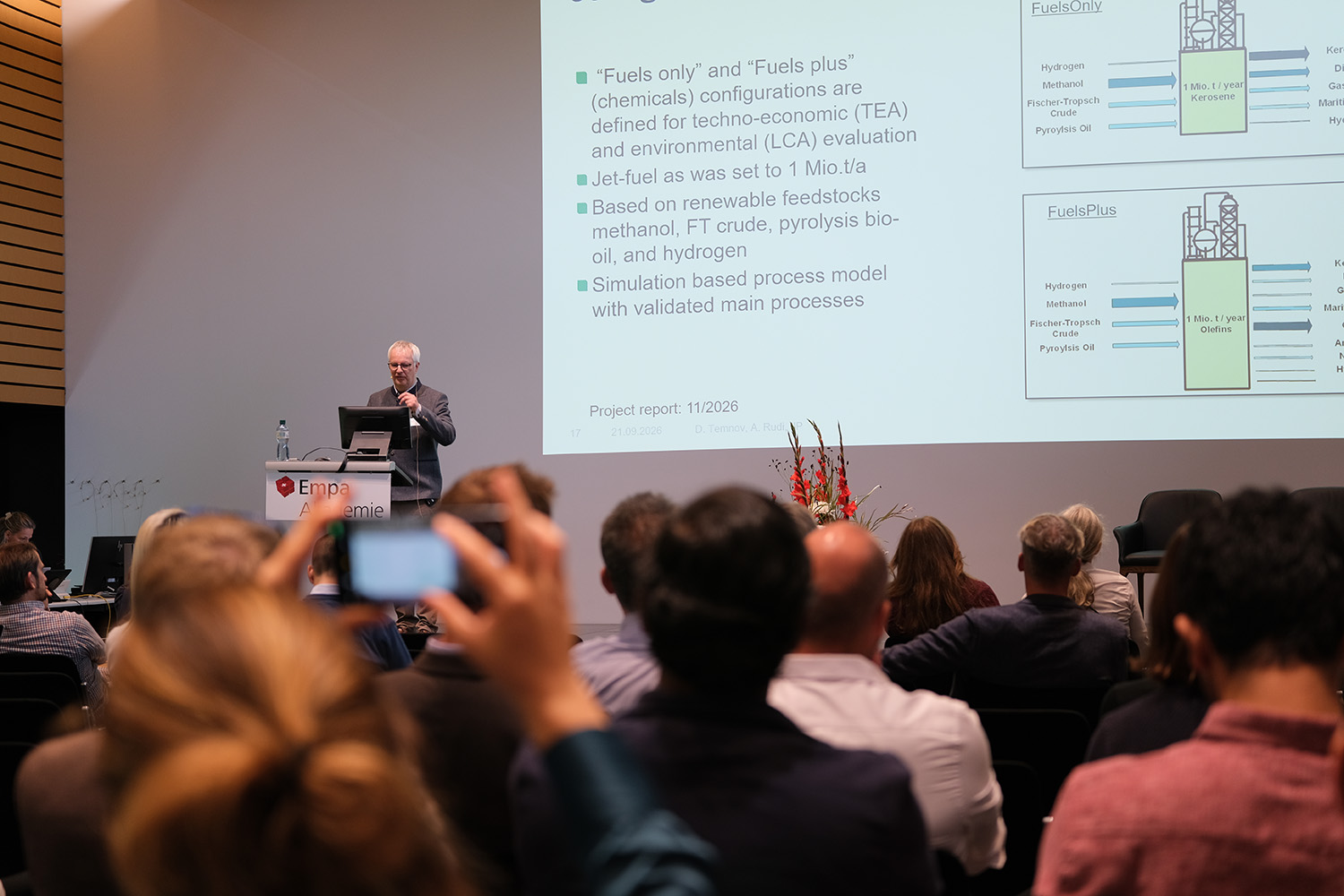
Approximately 100 participants, with around half representing the private sector and federal offices, gathered at the V-Zug premises to discuss the initial results of the young consortium and to receive input from external experts.

Bernhard Dietrich gave an impressive presentation on "Forecasts for Renewable Aviation Fuel and Its Consequences." He explained that numerous Power-to-X (PtX) projects are currently under development. However, after the feasibility studies, many of these projects face a significant risk of termination. Experience has shown that the primary reasons for this include unclear regulatory and legal situations, new and complex technologies, and uncertain demand. As a result, (used) vegetable oil is currently and for the medium term the preferred raw material for aviation fuel. However, all parties agreed that the quantities available in the long term will not be sufficient.

For the researchers in the consortium, this underlines the need to solve the open social and technical issues for the time when vegetable oil-based fuels are no longer sufficient to ensure the necessary reduction in greenhouse gases.

Frederic Vogel introduced a different way to produce jet fuel via biomass, such as green waste, manure, or wood residues. He summarized the state of the art and the challenges associated with sourcing bio-oil from these biomass substrates through hydrothermal liquefaction. This bio-crude serves as a precursor for various types of fuels.

These topics were also the focus of panel discussions and the poster session that took place on this day.

Besides aviation, high-temperature processes in industry are also facing significant decarbonization challenges. During the lunch break, V-Zug, the event's host, invited the participants to a guided tour of the enameling oven. Christian Bach explained that V-Zug is pursuing plans to use hydrogen for heat-intensive processes and to extract it from methane through pyrolysis. This process removes the resulting carbon from the atmospheric carbon cycle as pellets.

In summary, it was an informative day that offered insights via specialist presentations and plenty of opportunities for informal discussions.

Selected presentations from the day can be downloaded here: Link
‍

Share this post
PUBLICATIONS

Latest findings from research

Research Paper Energy & Environmental Science
Documents

Haber–Bosch 2.0 for low-carbon ammonia production: a global techno-economic and environmental assessment

Decentralized ammonia production via electric Haber–Bosch (Haber–Bosch 2.0) could support shipping, chemical manufacturing, and local fertilizer supply chains. Unlike conventional Haber–Bosch systems, Haber–Bosch 2.0 technologies operate at lower pressures (∼30–60 bar) and temperatures (∼400 °C), enabling smaller, modular ammonia systems powered by low-carbon electricity. However, its economic viability and environmental performance under diverse conditions remain unclear. Here, we apply techno-economic and environmental life cycle assessment using a novel, open-source framework to optimally design ∼13 000 grid-connected, hybrid, and off-grid electric Haber–Bosch configurations worldwide. Our results demonstrate that decentralized ammonia production costs are between €740–4100 tNH3−1, which is substantially higher compared to centralized ammonia production (∼300 tNH3−1 historically with recent spikes up to ∼€800 tNH3−1). Hybrid configurations exhibit the lowest costs (€740–2090 tNH3−1), particularly in regions with low grid electricity prices, low capital costs, and/or abundant renewables. However, their GHG emissions vary widely depending on the GHG intensity of the local grid. Off-grid systems exhibit the lowest life cycle GHG emissions (on average 0.70 tCO2-eq. tNH3−1), but demonstrate high costs (more than €1100 tNH3−1), driven by oversized renewables and energy storage media to enable continuous Haber–Bosch operation. Cost parity may be achieved by 2050 through technology learning, especially for hybrid systems (€325 tNH3−1). To realize this potential and secure low-carbon fertilizer supply, policymakers should; (1) accelerate the decarbonization of national power grids, (2) provide early-stage deployment support for flexible, electric Haber–Bosch technologies, and (3) establish clear certification standards for low-carbon ammonia.
October 9, 2026